

What Is A Forex Funding Challenge? – FundingRock
Here’s the uncomfortable truth most prop firms won’t tell you: The biggest challenge isn’t the profit target. It’s the mental trap beginners have of “sizing illusion.”
When beginner traders see a $100,000 Forex Funding Challenge, their minds immediately lock onto that six-figure number. They think they’re trading with $100,000 of breathing room. But they’re wrong.
In reality, you only have your Drawdown Limit (usually around 10%, or $10,000 in this case). Lose that $10,000, and the entire “six-figure” account vanishes. The psychological disconnect between the account size you see and the buffer of simulated funds you actually control is the silent killer that eliminates 89% of traders before they ever see a reward.
So in this post, we’ll break down exactly what a Forex Funding Challenge is, how the three-phase evaluation process works, what it costs to get started, and most importantly, how to avoid the mental traps that destroy accounts before traders even understand the real game they’re playing.
TLDR:
A Forex Funding Challenge is a prop trading evaluation where you prove you can trade profitably with simulated funds. But 89% of traders fail because they focus on the big number instead of their actual drawdown limit.
The structure is simple: Pass Phase 1 (8% profit target, 11% pass rate), survive Phase 2 (5% profit target, 9.26% pass rate), then trade with simulated funds with up to 90% reward shares. Costs range from $59 to $999 depending on account size, and most firms refund your fee after your first reward.
What Is A Forex Funding Challenge?
A Forex Funding Challenge is a prop trading program that allows traders to access simulated funds for trading in the foreign exchange market.
How Do Forex Funding Challenges Work?
Most prop firms use a two-phase evaluation structure. The first phase is the challenge phase, where traders must demonstrate their ability to trade profitably while following predefined rules and objectives.
After passing the initial challenge, traders move on to the verification phase. The verification phase is designed to confirm consistency and ensure the trader can maintain disciplined performance over time.
After successfully completing both phases, the trader receives a funded account. The prop firm then provides simulated funds, allowing the trader to trade on the firm’s behalf in exchange for sharing profits under the established guidelines.
What Are The Phases Of A Forex Funding Challenge?
Every Funding Challenge follows the same essential structure. It doesn’t matter if you’re evaluating with FundingRock or any other prop firm, you’ll progress through three distinct phases:
Phase 1: The Challenge
Phase 1 is the evaluation stage that puts traders to the test to see if they can generate profits while following strict risk rules. The objective is to reach a profit target, which is around 8% to 10%, without breaking limits such as a 5% maximum daily loss and a 10% maximum drawdown.
Unfortunately, fewer than 11% of traders pass Phase 1 across the industry. Most failures come from issues that can be avoided like poor risk control, over-leveraging, or emotional decision-making instead of having a strategy.
Let’s use FundingRock as an example to show what Phase 1 looks like in real terms. It offers different accounts, but let’s go with a $100,000 account.
To pass, you need to reach an 8% profit target or $8,000 while staying within a 5% daily loss limit of $5,000 and a 10% maximum loss of $10,000. There is a minimum of 4 trading days, and leverage is set at 1:100. Trading takes place on a simulated account using Forex pairs like EURUSD, GBPUSD, USDJPY, AUDUSD, and USDCAD.
Phase 2: Verification
Phase 2 is the final verification stage where traders prove they are consistent and disciplined in risk management. The profit target is lower than Phase 1, usually around 5%, while drawdown rules typically stay at 5% maximum daily loss and 10% maximum loss.
The rules during this phase are focused on steady execution instead of aggressive growth. Firms review profitability, consistency, and adherence to risk limits over the required trading days. The goal is to confirm that Phase 1 performance can be repeated under controlled conditions.
That said, only about 9.26% of traders successfully pass Phase 2, making it one of the most difficult steps in the evaluation process.
Coming back to the FundingRock $100,000 example, Phase 2 requires a 5% profit target or $5,000 while staying within a 5% daily loss limit of $5,000 and a 10% maximum loss of $10,000. There is also a minimum of 4 trading days, and leverage is set at 1:100. After passing this phase the trader becomes funded.
Phase 3: Funded Trader
Phase 3 is the funded stage where a trader manages simulated funds provided by the firm. Trading takes place on a funded account under strict risk management rules such as daily drawdown and maximum drawdown limits. The profits generated on the account are split, commonly starting at around 80%, with higher reward shares offered by some firms.
That said, account activity is continuously monitored to ensure traders comply with risk rules. It’s important to stay within daily and overall loss limits to remain funded and eligible for rewards. Most firms offer regular reward cycles, including weekly, biweekly, or monthly options, once minimum withdrawal conditions are met.
Building on the FundingRock $100,000 example, the FundingRock Account sets a maximum daily loss of 5% or $5,000 and a maximum loss of 10% or $10,000, and the leverage remains at 1:100. Traders keep 80% of profits, with the first withdrawal including a 100% fee refund.
FundingRock allows biweekly rewards once accumulated profits exceed $100. Withdrawals become available only after achieving funded trader status, and profits can currently be withdrawn through Riseworks.
How Much Does A Forex Funding Challenge Cost?
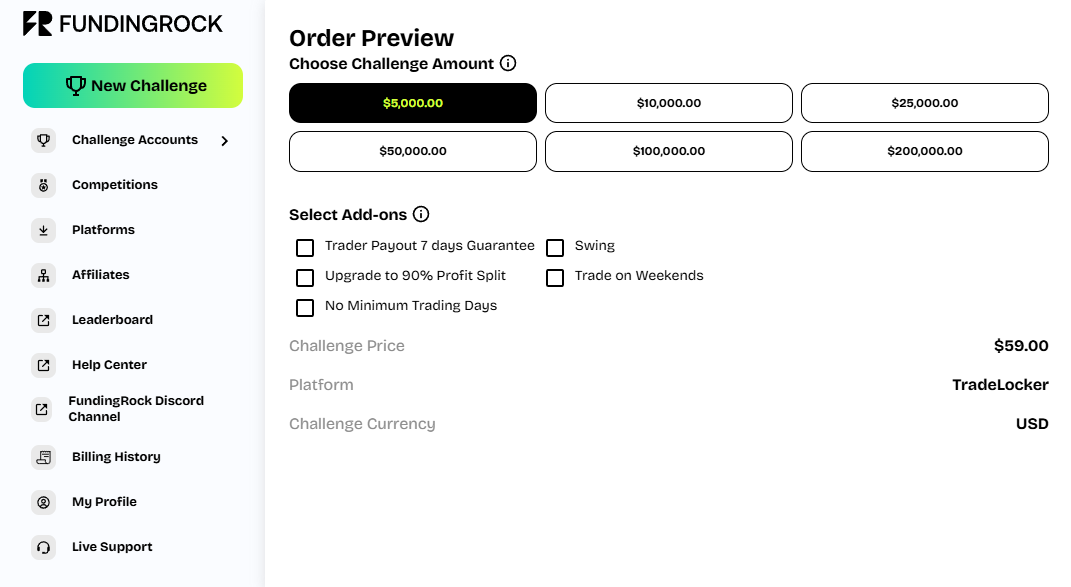
Challenge costs generally range from $50 to $1,000 or more, depending on the prop firm, account size, and challenge structure. Popular $100,000 challenges typically fall between $450 and $600.
Fees are paid upfront and grant access to a simulated funded account. Some firms refund the fee after the trader passes the challenge and reaches the first reward.
For example, FundingRock offers multiple pricing tiers based on account size:
- $5,000 account: $59
- $10,000 account: $99
- $25,000 account: $219
- $50,000 account: $349
- $100,000 account: $549
- $200,000 account: $999
How To Get Started In Forex Funding

Start by visiting our homepage and clicking “Join Now” or “Get Started.” Create an account using your email address or Google single sign on, then confirm your registration by clicking Complete Registration in the verification email sent to your Gmail inbox.
After registration, access the FundingRock dashboard and select the evaluation account that fits your goals. Head to the “Challenge” section, click “New Challenge” in the top-left corner, and enter your trading account with one click to start trading right away.
That’s it. The entire process is very easy to follow so you don’t have to worry about it being complex.
Conclusion
The difference between funded traders and failed attempts is understanding the actual challenge. A prop challenge isn’t about managing the full amount, it’s mainly about protecting the 10% max loss allowed and being able to reach the profit target. The 11% who pass Phase 1 and the 9.26% who make it through Phase 2 are simply the ones who understood what this test was all about from day one and those who are able to control their emotions when trading.