

How Do Trading Challenge Resets Work?
Failing a trading challenge stings. Beyond the financial loss, there’s the frustration of knowing you were close, the self-doubt that creeps in afterward, and the mounting pressure to get it right on the next attempt. But what makes it worse is the financial weight that comes with starting over.
The good news is that most prop firms offer reset options designed to ease that burden.
In this post, we’ll break down exactly how trading challenge resets work, when they happen, and the different types available to you.
TLDR:
Did you blow your prop trading challenge? Don’t worry, most firms let you reset your account instead of buying a whole new evaluation. There are three main types:
- Automatic resets (kicks in when your subscription renews)
- Discounted resets (cheaper than a new challenge, but usually time-limited)
- One-time free resets (exactly what it sounds like, use it wisely)
Resets typically happen after you hit a drawdown limit, break a rule, or run out of trading days. The key is knowing your firm’s specific reset policy before you need it.
What Is A Trading Challenge Reset?
A trading challenge reset is a feature offered by prop firms that allows traders to restart an evaluation account from its original state. The account balance, targets, and rules are restored, giving another chance to pass the evaluation without purchasing a new challenge.
When Do Resets Happen?
Resets happen after a trader fails a challenge or reaches a point where passing is no longer realistic under the rules. For example:
- Hitting a maximum drawdown limit, either daily or total.
- After breaking consistency rules, violating trading restrictions like allowed hours, instruments, or strategies, or running out of trading days before reaching the profit target.
- Large losses can push the account so far from the profit target that continuing no longer makes sense.
- Emotional decisions after losses often make the situation worse, leading traders to reset instead of trying to recover from a weakened balance.
After a reset, the account starts fresh at the original balance tied to the purchase. Any previous profits or losses are removed and don’t carry over.
Many firms offer resets at a reduced cost compared to restarting the challenge. Some refer to this option as a retry or second chance, and traders can purchase multiple resets until they pass and receive a funded account.
How Resets Usually Work
Not all prop firms handle resets the same way. Some offer automatic resets tied to your subscription, others provide discounted restart options, and a few give you one free chance to try again. That’s why you need to understand how each type works so you can choose the right firm and plan your approach.
Here’s a breakdown of the most common reset structures you’ll encounter.
Automatic Reset
An automatic reset is a feature that restores an evaluation or challenge account to its original starting balance and settings after a trading rule is broken. Reset policies are designed to simplify account management and reduce unnecessary fees for traders.
How Does It Work?
If an evaluation account fails and the subscription remains active, a reset may be applied automatically upon renewal (only if specific conditions are met). For example, the account must be in failed status as of the market close on the trading day before the renewal date, and the subscription renewal fee must be successfully charged.
The reset is applied only after the renewal payment is processed and usually happens on the next billing cycle. The account is restored automatically, so there’s no need to cancel the subscription or create a new account to resume trading.
Discounted Reset
A discounted reset is a feature that allows traders to restart a failed evaluation account at the original balance for a lower cost than buying a new challenge. The goal is to reduce the financial hit of a failed attempt and allow traders to continue without unnecessary delays.
How Does It Work?
All prop firms handle discounted resets and rules differently. For example, FundingRock allows discounted resets only after a Phase 1 challenge failure and only within 24 hours of the failure. The reset eligibility expires once that window closes.
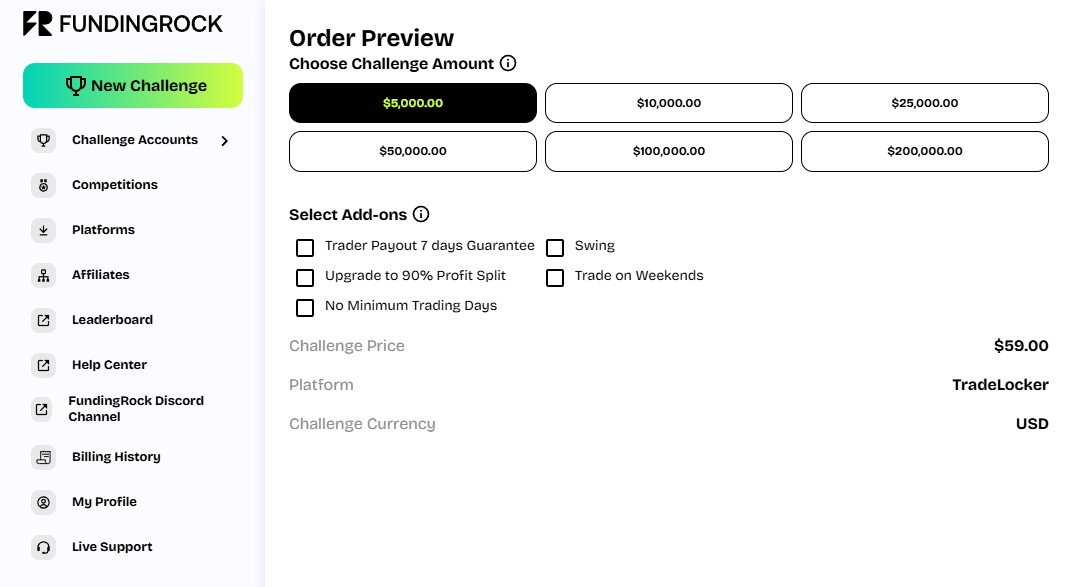
Let’s say you’re a trader using FundingRock and you are in need of a reset. You would have to log into your Dashboard and open the Challenge Accounts section. Then you’ll see the failed challenge on the list where you’ll be able to select it to view the available actions. If your account is eligible, you’ll be able to see the Reset Challenge option.
If you click on it, a pop-up will appear showing the discounted reset percentage. You’ll then choose a payment method and confirm the reset, which makes the challenge restart immediately.
After that, the reset will restore the account to its original starting balance based on the purchased account size. All previous profits or losses are removed, and you restart Phase 1 under the same challenge rules.
One-Time Free Reset
A one-time free reset is a feature that allows a trader to restart an evaluation or challenge for free after breaking a trading rule, such as reaching a drawdown limit. The goal is to give traders another opportunity to pass without paying for a new evaluation.
How Does It Work?
A free reset is usually available after an evaluation fails due to a rule violation instead of normal trading losses. The account is set back to its starting point, including the original balance and trading conditions, so the trader can begin again from the same setup.
The account often stays in the same dashboard and may keep the same account number, although some multi-phase challenges create a new account. Trading rules and profit targets remain unchanged. But evaluation time limits don’t always reset, so any remaining time may still apply.
Most firms limit the free reset to one use per account or per challenge phase. After the free option is used, additional resets usually require payment. Some firms only provide a free reset as part of a limited-time promotion for new evaluations.
Conclusion
Trading challenge resets exist for one reason: to give you another opportunity to prove yourself without starting completely over. Whether you’ve hit a drawdown limit, violated a rule, or simply run out of time, resets let you restart your evaluation at the original balance (often at a reduced cost or even for free).
The key is understanding when resets apply, how each firm structures them, and which option makes the most financial sense for your situation.
So before you purchase your next challenge or pay for a reset, take the time to review the firm’s policies. Some offer automatic resets with active subscriptions, others provide discounted restarts within a short window, and a few include a one-time free reset as part of the package.